
Last Updated: October 28, 2026
Quick Summary
Nervous system regulation is the body’s ability to move from alertness back to calm, and simple exercises can help partners do this during stress. Start with solo practices like slow exhale breathing and five-senses grounding, then use a timed pause and a 90-second reset during arguments. Co-regulation, such as breathing together, can help both partners settle when both feel safe.
- Slow exhale breathing: inhale for four counts, then exhale slowly for six or eight, for two minutes.
- Five-senses grounding takes about three minutes: name things you see, feel, hear, smell, and taste.
- Agree on a pause signal and a time limit before a difficult conversation starts.
- Choose a 90-second reset that matches your stress response, such as pushing against a wall for fight.
- Do not use co-regulation if there is abuse, threats, or intimidation; seek professional support instead.
Table of Contents
- What Nervous System Regulation Means Between Partners
- Recognizing Your Triggers and Early Warning Signs
- Solo Breathing and Grounding Exercises to Start With
- How to Calm Down During an Argument
- Co-Regulation Exercises for Couples
- Repairing the Relationship After a Stressful Conflict
- Building Your Practice and Starting Your First Session This Week
- Frequently Asked Questions
Nervous system regulation sounds like clinical jargon, but it can describe everyday moments between couples: the sharp tone during a dinner argument, the walk out of the room, the silence that follows. The body reacts before the mind catches up.
This guide covers what regulation means between partners, how to spot your triggers, solo and shared exercises, and how to repair after conflict.
What Nervous System Regulation Means Between Partners
Nervous system regulation is the body’s ability to move between alertness and calm. Between partners, it describes how well each person settles their own body when stress hits, and how a partner’s calm can help them settle too.
Emotional regulation focuses on managing feelings and thoughts. Nervous system regulation is more physical: heart rate, breathing, muscle tension, and the urge to fight or flee.
How Stress Responses Show Up in Relationships
Stress responses rarely look dramatic. They often look like:
- Going quiet or shutting down mid-sentence
- Speaking faster, louder, or more sharply than you meant to
- Feeling a knot in the stomach or heat in the face
Partners often misread these signals as rejection or anger, when the nervous system may simply be in protection mode.
The Fight, Flight, Freeze, and Fawn Responses
Most people know fight and flight. Freeze and fawn are less discussed but common in relationships:
- Fight: Pushing back, arguing, raising your voice to be heard.
- Flight: Leaving, changing the subject, or staying busy to avoid tension.
- Freeze: Going numb or blank, unable to find words.
Knowing which pattern is yours is the first step toward responding with more choice.
Recognizing Your Triggers and Early Warning Signs
Before you can regulate, you have to notice you’re getting dysregulated. Stress builds in stages, and the earlier you catch it, the easier it is to settle.
Common early warning signs include:
- A tight chest or shallow breathing
- Clenched jaw or hands
- Racing thoughts that focus on what your partner “always” or “never” does
Keep a simple note on your phone for one week. If you want to understand how being yourself can build the connection you’re looking for, explore how to build connection by being yourself.
Solo Breathing and Grounding Exercises to Start With
You don’t need a partner to start. These exercises build your baseline so you have something to reach for when conflict arrives.
Slow exhale breathing (2 minutes)
- Sit comfortably with your feet on the floor.
- Breathe in through your nose for a count of four.
- Breathe out slowly through your mouth for a count of six or eight.
- Repeat for two minutes. A longer exhale tends to signal the body to slow down.
Five-senses grounding (3 minutes)
- Name five things you can see.
- Name four things you can feel (your chair, your feet, the air).
- Name three things you can hear.
Gentle shaking (1 minute)
Stand, let your knees soften, and gently shake your hands, arms, and legs for about a minute.
Practice daily for a few weeks, not just during fights, regular practice makes these easier to reach for under stress.
How to Calm Down During an Argument
Arguments escalate fast, so have a plan before you need one. This sequence is designed for use during a heated moment, takes about 10-15 minutes, and adapts to your stress response style. Practice it when calm so it becomes automatic under pressure.
A Timed Sequence for Before, During, and After a Difficult Conversation
Most advice says “take a break” without specifying what to do in it. This sequence fills that gap, and you do it with your partner’s awareness, not in isolation.
Before the conversation (2 minutes):
- Agree on a signal. Choose a word or gesture (e.g., “pause,” a raised hand, or a time-out sign) that either of you can use to initiate a break without it feeling like rejection.
- Set a time limit. Say, “Let’s talk for 10 minutes, then check in.” This prevents the conversation from feeling endless.
- Do a quick body scan together. Facing each other, breathe in through the nose for four, out through the mouth for six. Repeat three times. This isn’t about full calm, it signals you’re starting on the same page.
During the conversation (when you notice escalation):
- Use the signal. One partner says the agreed word or makes the gesture.
- Name the pause out loud. “I’m using our pause. I need five minutes.” This keeps the other person informed and reduces feelings of abandonment.
- Separate physically if possible, another room or outside. If you can’t leave, turn slightly away and fix your gaze on a wall or the floor to reduce visual stimulation.
- Do a 90-second reset. Set a timer on your phone. For 90 seconds, do one of the following based on your stress response:
- If you tend to fight (anger, raised voice): Push your palms against a wall or press your feet hard into the floor. This discharges physical energy without confrontation.
- If you tend to flee (urge to leave, restlessness): Walk briskly in place or pace slowly while counting your steps. Give the urge to move a safe outlet.
- If you tend to freeze (numbness, blank mind): Rub your hands together vigorously, then place them on your cheeks. Or hold an ice cube for 30 seconds. Strong sensory input can help you re-engage.
- If you tend to fawn (over-agreeing, people-pleasing): Place one hand on your chest and one on your belly. Say silently, “I am allowed to have my own reaction.” Then write down one sentence about what you actually feel before returning.
- Return with one sentence. Start with what you want to understand, not what your partner did wrong, e.g., “I want to understand what you meant when you said X.” This keeps the focus on curiosity, not blame.
After the conversation (5 minutes):
- Debrief briefly. Each partner shares one thing that helped and one that didn’t, two minutes each.
- Do a shared grounding exercise. Sit side by side for three slow breaths, or hold hands for 30 seconds if both are comfortable. This signals safety after conflict.
- Agree on a repair signal for next time, a phrase like “let’s reset” or a gesture meaning “I’m still here, I just need a moment.”
If you or your partner find breath focus uncomfortable (common for people with trauma histories), substitute the breath count with a simple action: tap your collarbones alternately for 30 seconds, or press your feet into the floor and notice the pressure. The goal is to give your nervous system a predictable, safe sensation, not to force relaxation.
Adapting the Sequence to Different Stress Responses
Not everyone responds to the same exercise. Use the table below to choose the reset that fits your pattern. If unsure, try one and notice whether it settles or agitates you, stop if it increases distress.
| Stress Response | What It Feels Like | Best Reset During a Break |
|---|---|---|
| Fight | Heat, tension, urge to argue | Push against a wall, stomp feet, or squeeze a pillow |
| Flight | Restlessness, urge to leave | Walk briskly, shake limbs, or change rooms |
| Freeze | Numbness, blank mind, shutdown | Strong sensory input: cold water, ice, vigorous hand rubbing |
| Fawn | Over-agreeing, losing your own view | Hand on chest, write your own perspective, practice saying “I need to think” |
A common mistake is trying to resolve everything during the break. Your only goal is to lower the temperature enough to talk. If you return still activated, use the signal again, needing multiple breaks isn’t failure.
If arguments regularly involve threats, intimidation, or physical aggression, a structured break may not be safe. In those situations, prioritize your safety and seek support from a qualified professional or domestic violence resource. Co-regulation exercises assume both partners feel safe enough to participate voluntarily.
Co-Regulation Exercises for Couples
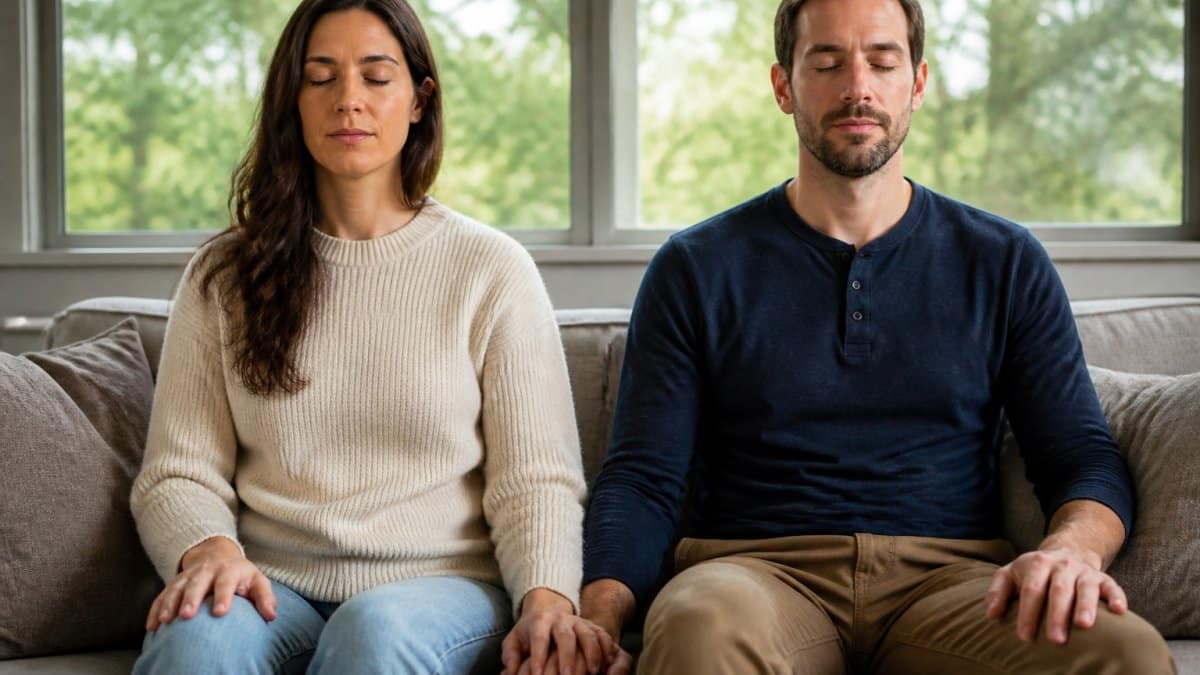
Co-regulation means partners help each other settle through calm presence, a calm voice, steady breathing, and soft eye contact can help both come down from stress. The exercises below are grouped by sensory preference and stress response, with options for couples who are apart.
Shared Breathing and Gentle Movement Together
Try these together, ideally when you’re both relatively calm. If one of you feels pressured, stop.
- Breathing in sync (2 minutes): Sit facing each other or side by side and breathe slowly together, matching exhales. If breath focus is uncomfortable, hum together instead, humming naturally lengthens the exhale.
- Walking together (10 minutes): Walk outside without discussing the problem, nature and rhythmic movement make later conversation easier. If weather or mobility is an issue, walk indoors or march in place side by side.
- Gentle stretching or swaying (1 minute): Stand together and sway slowly side to side, or do light stretches side by side. This provides rhythmic movement without the intensity of exercise.
Adapting Co-Regulation to Different Stress Responses and Sensory Needs
Some people find closed eyes or breath focus distressing; others need more movement. Adapt with this guide:
- For fight responses: Choose activities with physical resistance, push palms together, stand back-to-back and lean slightly, or squeeze a pillow together. Avoid soft eye contact if it feels confrontational; sit side by side instead.
- For flight responses: Choose rhythmic movement, walking, swaying, or passing a ball back and forth. Keep the body engaged to channel restlessness.
- For freeze responses: Choose gentle sensory input, wrap in a blanket together, hold a warm mug, or listen to a short guided audio. Avoid demanding verbal interaction.
Consent is ongoing. A partner may agree to an exercise and then change their mind mid-way. Agree on a signal, like tapping your own shoulder twice, that means “I need to stop now” without needing to explain.
Remote and Long-Distance Co-Regulation
You can co-regulate without being in the same room. These practices work over phone, video, or even asynchronously:
- Synchronized breathing on a call: Set up a video call and breathe together for two minutes with cameras on. If video is not possible, do it on speakerphone and say “in” and “out” softly to stay in sync.
- Shared audio grounding: One partner reads a five-senses grounding script while the other follows along. Swap roles next time.
- Asynchronous voice notes: Record a 30-second voice message describing what you see, hear, and feel in your environment. Send it to your partner and ask them to do the same. Listening to a calm voice can be regulating even when apart.
When Co-Regulation Is Not Appropriate
Co-regulation only works when both people feel safe and willing. Step back when:
- One partner says they feel uncomfortable, pressured, or want space.
- There is abuse, threats, or intimidation in the relationship.
- A partner is in acute crisis and needs professional support instead.
Always ask before suggesting a shared exercise, and accept a “no” without argument, respecting boundaries is part of regulation. If unsure whether co-regulation is safe for your relationship, consult a licensed therapist or call a domestic violence hotline.
Repairing the Relationship After a Stressful Conflict
Even well-regulated couples have hard conversations. What matters most is what happens afterward.
- Wait until both of you are calm. Repair attempts made while still activated usually spark another fight.
- Name your part. Say something like, “I raised my voice, and I’m sorry. That wasn’t fair to you.”
- Share what you needed. Explain what would have helped, such as a pause or more time to think.
Repair is less about a perfect apology and more about showing your partner you’re willing to come back together. If your partner has grown distant after a fight, learn what actually brings a husband back.
Building Your Practice and Starting Your First Session This Week
Start small. Pick one solo exercise and practice it five minutes each morning this week.
Track how you feel before and after each session. If you want to reconnect desire without explaining your feelings at length, read how to rebuild desire without explaining every feeling.
For more on understanding how your partner experiences connection and stress, explore the free resources available at Relationship Headquarters.
Frequently Asked Questions
What are the best exercises for nervous system regulation in relationships?
The most useful starting points are slow breathing with a longer exhale, grounding by naming five things you can see and feel, and a brief pause before replying. For couples, shared practices such as breathing in rhythm or walking side by side at an easy pace work well. Start with one exercise, practice it when things are calm, and then use it during tense moments. Consistency matters more than intensity, and a short daily practice usually builds more capacity than one long session.
How can I calm my nervous system during an argument with my partner?
Name the moment to yourself first: notice a racing heart, tight jaw, or urge to leave. Then slow your exhale, lower your voice, and ask for a short pause, such as ten minutes, with a clear plan to return. Keep your feet on the floor and your attention on one physical sensation. Avoid trying to win the point during the pause. The goal is to get your body back to a state where you can listen, not to resolve everything in the moment.
What is co-regulation in a relationship?
Co-regulation is the process by which one person’s calm, steady nervous system helps settle another’s. It happens through tone of voice, facial expression, touch when welcome, and predictable responses. Partners can practice it deliberately by matching a slow breathing rhythm or sitting close without talking. It does not mean one person takes responsibility for the other’s feelings. Both partners can offer and receive regulation, and either can decline it without it being a rejection.
Can breathing exercises help with relationship anxiety?
Breathing exercises are one practice you could try alongside other steps, such as naming what you feel and deciding what you need from your partner. If anxiety is persistent or severe, a qualified mental health professional can offer support beyond self-help exercises.
Mindful breathing and grounding can help many people feel steadier, but they are not a replacement for professional mental health care. If stress, conflict, or fear feels overwhelming, or if you are in an unsafe relationship, please reach out to a qualified therapist or local support service.